
Liberty County Projected and Actual Dates
A projected date is a calculation or planning date. An actual release date records an event that occurred. The distinction is vital in Liberty County because a jail detainee awaiting court action has no sentence-based release date. Bond, a court order, dismissal, another agency's hold, or transfer may determine when that person leaves. A sentenced county inmate and a GDC prisoner follow different date systems.
Georgia state records use several labels. A maximum possible release date, sometimes called the max-out date, reflects completion of the full term under the state definition. An actual release date reports a completed release. A Tentative Parole Month, or TPM, is when the Parole Board plans final review. It is not a release order.
Find Liberty County Projected Release Dates
First identify the system that owns the sentence. The Liberty County current roster is useful for local custody but is not a state release-date calculator. A person transferred to GDC should be searched in the state offender query. A person serving a county sentence should be checked through jail records and the sentencing court. A pretrial detainee should be checked for bond, court orders, and holds rather than a projected date.
- Read the custody source and identify Liberty County Jail, a GDC institution, or federal custody.
- For GDC, search by GDC ID when known. Otherwise use full legal name and compare age, case, offense, and institution.
- Include inactive offenders, or both active and inactive, when release may already have occurred.
- Read the full field label: maximum possible, actual release, current status, sentence end, or TPM.
- For a county sentence, ask the jail records unit or sentencing court for the commitment, sentence, earned-time, and discharge record.
The GDC Offender Query carries a warning that its information may be incomplete or inaccurate. GDC directs written verification to Inmate Records and Information, PO Box 1529, Forsyth, GA 31029. A common name alone is not enough to identify a Liberty County inmate.
Georgia State Release-Date Credits
Georgia does not use a single rule that every prisoner serves the same percentage. Many parole-eligible prisoners may be considered after one-third of a felony sentence or nine months under O.C.G.A. 42-9-45, subject to exceptions. The Board can deny parole or establish a TPM after applying its guidelines. Non-life sentences for serious violent felonies listed in O.C.G.A. 17-10-6.1 may be ineligible for parole and require service of the prison term imposed.
GDC's Performance Incentive Credit program is limited to eligible state offenders. Up to 12 earned points may reduce a TPM or maximum release date by one to 12 months. Points may come from a reentry case plan, education or vocational improvement, and work assignments. Excluded groups include several short, mandatory, life, death, and non-parole-eligible sentences. PIC is not a county jail bond rule.
The state credit framework therefore has several decision points: statutory eligibility, Board discretion, conduct, program credit, sentence type, and holds. A projected date should not be reduced by a homemade percentage. Use the actual GDC and Board record.
Life sentences require their own review. Board material describes different eligibility markers based on the offense and date, including seven, fourteen, or thirty years in the categories it summarizes. A life case receives a grant or denial rather than an ordinary non-life TPM result. Check the sentence and offense date before applying a general timeline.
Why Liberty County Release Dates Change
A date changes when the law, sentence calculation, custody status, or parole decision changes. County detainees can bond out or receive a court order. State inmates may gain credit, lose a favorable planning date after misconduct, or face a detainer. A detainer is a request or legal basis for another agency to take custody when the current custody ends.
| Factor | Possible effect |
|---|---|
| Bond or court order | Creates or changes a pretrial county release path |
| Earned credit | May shorten a county or eligible state sentence under the governing rules |
| Misconduct | May postpone or cancel a TPM or affect credit |
| Parole decision | May establish, advance, postpone, deny, or withdraw release planning |
| Detainer or hold | May cause transfer instead of community release |
| Sentence recalculation | Can change the maximum or projected date |
Life sentences have separate eligibility timing and do not receive ordinary TPM results in the same way as non-life cases. Serious violent felony eligibility can depend on the offense and offense date. These differences are why a single online date needs its full case context.
A hold can change the meaning without changing the day someone leaves a building. If another agency assumes custody, the inmate left one facility but did not return to the community. Trace a federal or other hold to the requesting agency before treating a local discharge as the end of custody.
Confirm Liberty County Release Dates
Use the agency that owns the record. Liberty County Jail can address a county custody or discharge record. The sentencing court can confirm its order. GDC maintains the state sentence and status fields, while the State Board controls parole decisions and TPM information. A screen result is useful for planning, but written agency verification is stronger when the exact date matters.
For a pending custody change, register through the Liberty County VINELink inmate search. VINELink supplies alerts, not the full date calculation. The Board's V.I.P. phone system can also provide eligible state users with location, parole status, and maximum or scheduled release information. A notification should still be checked against the source record.
The State Board TPM explanation shows why a TPM requires caution.
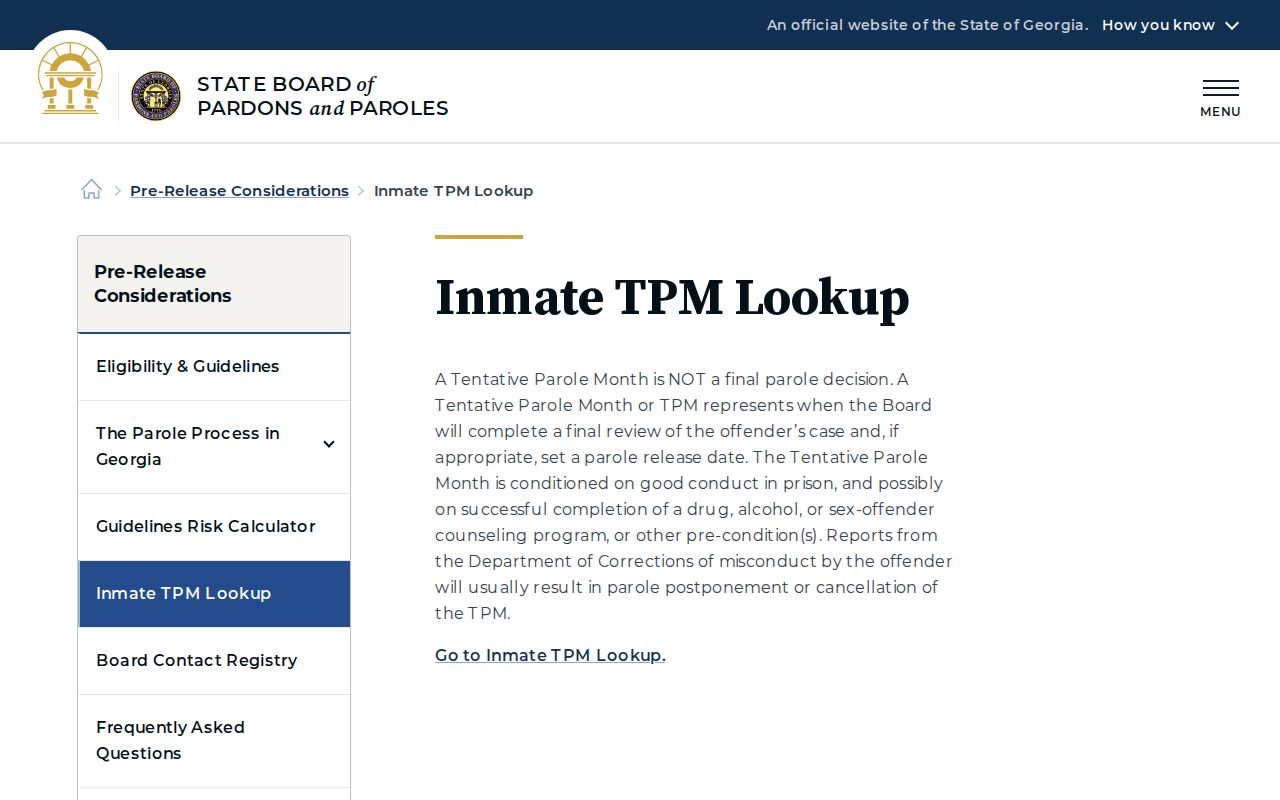
The Board treats the month as a final-review point, not a promise that the inmate will leave custody during that month.
Liberty County Jail Earned Time
County sentence computation has its own Georgia rule. O.C.G.A. 42-4-7 says a county inmate sentenced to confinement is released at sentence expiration less earned-time allowances. It also addresses records of commitment and discharge. This is not the same as GDC's PIC program or a parole decision.
No Liberty County-specific public good-time formula was found in the project research. The sound approach is to request the jail's calculation instead of claiming that every county inmate receives a fixed reduction. The statute applies to sentenced county inmates. It does not replace bond or court-order analysis for someone awaiting trial.
A useful county request identifies the inmate, case number, sentence start, sentence length, credited time, earned-time allowance, and discharge entry. Compare the jail calculation with the sentencing order. The court supplies the sentence, while jail administration maintains the confinement and discharge record.
The county inmate statute and discharge rule provides the legal source.
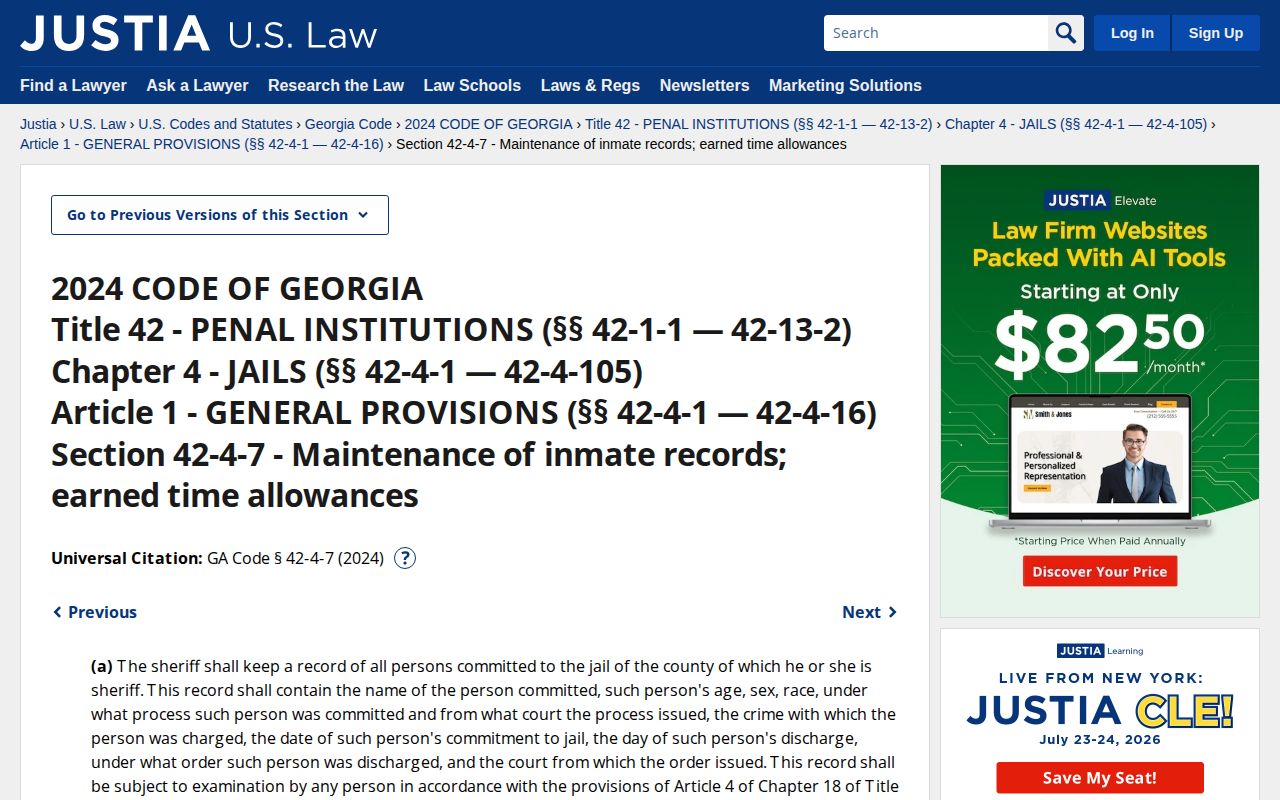
The statute supports a county-specific calculation while leaving the actual allowance record with jail administration.
Liberty County TPM Is Tentative
A TPM applies to parole planning for a state inmate. The Board completes a final review during the tentative month and may then set a release date. Good conduct and required treatment or counseling can be conditions. Misconduct reported by GDC usually leads to postponement or cancellation. The Board can reconsider a decision at any point before release.
For pre-release timing, use the Inmate TPM Lookup. For a person already released to parole, use the parolee database, which can show parole begin and end dates and the assigned office. Do not report the TPM as an actual release date.
The Board may require drug, alcohol, sex-offender counseling, or another precondition before release. Strong rehabilitation or PIC can advance some dates, while misconduct can postpone them. The result remains conditional until final review and release processing finish.
Match Liberty County Custody Systems
A local roster disappearance can mean community release, transfer to GDC, movement under a federal hold, or an online display change. Check GDC when the Liberty County case became a state prison sentence. Check the BOP locator after federal sentencing. A federal date may also change after sentence recalculation, and the federal locator warns that recalculation work can affect displayed dates.
The broad Liberty County released inmate lookup explains how to trace a person across county, state, court, and federal records. The key is to follow the legal custody, not merely the last building name shown. A transfer date is not a community release date.
Written verification remains the strongest choice when a displayed date will be relied upon. GDC directs correspondence to Inmate Records and Information at PO Box 1529, Forsyth, GA 31029. Include the GDC ID or case number when known, because a name-only match can join the wrong person to a maximum, actual, or parole-related date.