
Long Unit Release Destinations
Long Unit holds people in Georgia state custody. It is not a Liberty County jail, a municipal hold, or a federal facility. A person may leave Long Unit for community parole, completion of the state sentence, a period of probation ordered after prison, another GDC institution, or a detainer held by a different authority. “Released from Long Unit” can therefore mean the person left that building while remaining in custody elsewhere.
The correct source is the Georgia Department of Corrections Find an Offender page. The Liberty County InterOp roster covers local jail bookings and does not track Long Unit state-prison discharges. If a Liberty County booking vanished because the person received a state sentence, the GDC record is also the way to distinguish that transfer from a community release.
| Long Unit outcome | Verification source | Key detail |
|---|---|---|
| Moved within GDC | GDC offender query | Most recent institution and active status |
| Parole | Parolee Search | Parole begin date and assigned office |
| Sentence max-out | GDC record and written verification | Actual or maximum release date |
| Detainer transfer | GDC record plus receiving authority | Custody continues outside Long Unit |
Search Long Unit Release Records
The direct GDC offender query supports active offenders, inactive offenders, or both. A released person may be classified as inactive, so an active-only search can miss the needed record. Begin with a GDC ID when it is known. A name search should use the full legal name and enough filters to separate people with similar names.
- Open the GDC offender query from the official Find an Offender page.
- Select both active and inactive records, or search inactive records for a completed release.
- Enter the GDC ID, or use the person's full name with age, sex, race, or conviction county.
- Compare the most recent institution, case number, primary offense, and sentence dates.
- Read current status and actual release date separately from a maximum possible date.
- Request written verification if the date will be used in a court or records process.
The query includes last and first name, gender, race, age range, institution, alias, physical descriptors, sentence status, primary offense, conviction county, GDC ID, and case number. A detail result may show the incarceration start and end, actual release date, maximum possible release date, major offense, and current status. One matching name is not enough. Compare the identifiers and case facts.
Long Unit release research belongs in GDC systems. The Liberty County jail roster cannot confirm a state-prison discharge.
Long Unit Dates Explained
Georgia uses several date terms. The maximum release date is the point when the full sentence would end if served without an earlier parole decision. The actual release date records the custody exit that occurred. A Tentative Parole Month, or TPM, is a month for final Board review, not a promised day of release. Misconduct, unmet program conditions, new information, or a detainer can change the outcome.
- Parole
- Conditional community release granted by the State Board after part of a prison sentence.
- Probation
- Court-ordered supervision that may replace prison or follow a prison term.
- Max-out
- Completion of the prison sentence at its maximum release point.
- Detainer
- A request by another authority that can cause transfer instead of community release.
Georgia does not apply one simple “85 percent” rule to every state sentence. Parole eligibility, serious-violent-felony restrictions, Board guidelines, maximum dates, and earned credits vary by case. The Projected Release page explains these date types. Treat a TPM as planning information until the Board and GDC record show a final release.
Long Unit Parole Confirmation
The Inmate TPM Lookup applies before release. It can be searched with a six-digit inmate number, GDC ID, or personal details. The Board may establish, advance, postpone, cancel, or withdraw a parole plan before it becomes effective. A TPM result should never be restated as a completed discharge.
After parole begins, the State Board's Parolee Search is the stronger public channel. Its fields include parole begin date, parole end date, parole office, office number, and primary offense. Those details show that a person is outside prison but still supervised. The Probation & Parole page explains how the Georgia Department of Community Supervision fits the Liberty County path.
A probation tail comes from the sentencing court, not a Parole Board grant. Check the Liberty County case when a sentence was split between prison and probation. The court record supplies the imposed sentence, while GDC supplies prison custody and the Board supplies parole decisions.
Long Unit Records and Contact
The official GDC Long Unit location page is the source for the facility address and telephone number. Contact the facility for current operational routing. For a release date that needs formal confirmation, follow GDC's written-record instruction instead of relying only on a phone conversation or changing web result.
Long Unit1434 US Highway 84 East
Ludowici, GA 31316
912-545-3777
GDC tells users to verify offender information through personal written correspondence with Inmate Records and Information, PO Box 1529, Forsyth, GA 31029. Include the person's full name, GDC ID if known, date of birth when appropriate, and the precise record or date requested. GDC's general Inmate Concerns/Questions line is 404-656-4661.
The official location image below comes from the Long Unit page. It identifies the state facility whose release records are handled through GDC.
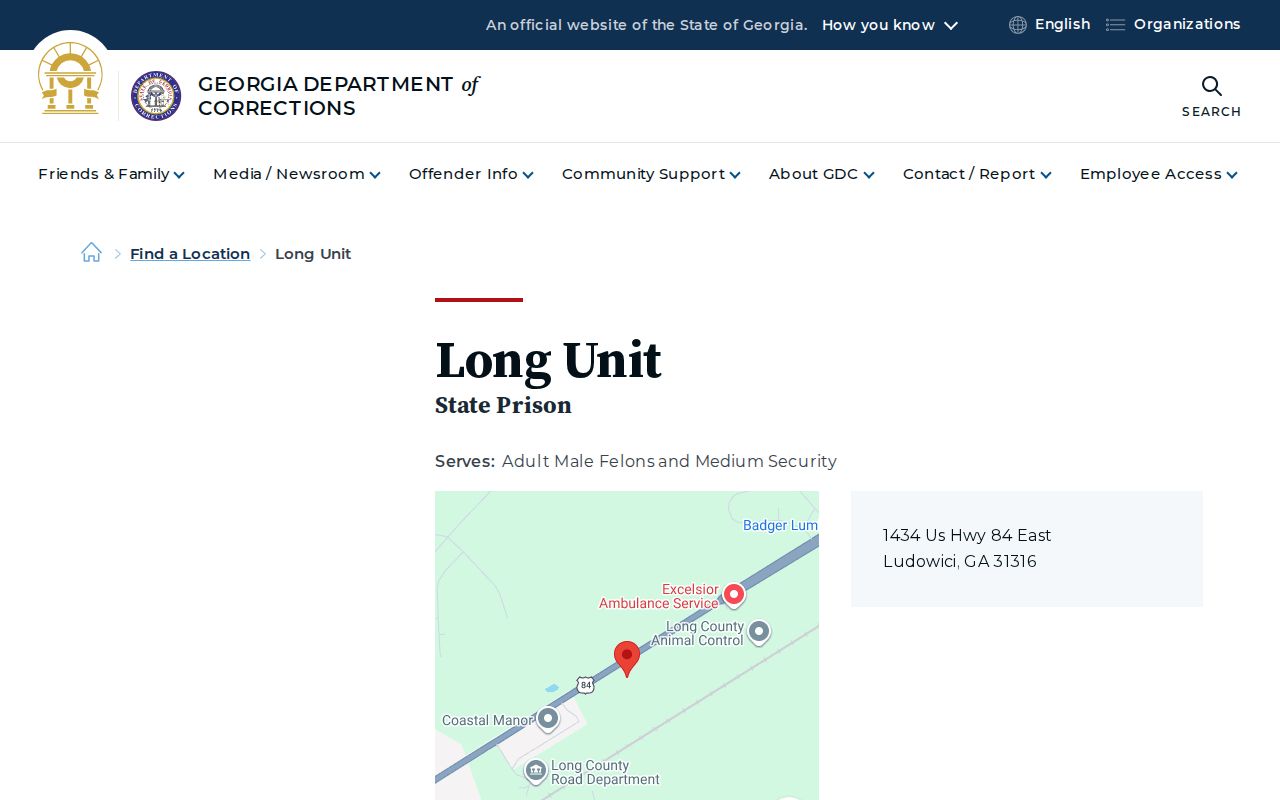
The facility listing establishes the contact point, while the statewide offender query supplies individual status and release dates.
Long Unit Release Notifications
Georgia has a separate state-prison notification channel. The Corrections and Parole Board V.I.P. line is 1-800-593-9474. With a six-digit case or EF number or a GDC ID, callers can obtain current incarceration location, parole status or eligibility, maximum or scheduled release date, and an indication when the person is not in custody. Registered victims and family members may receive a confirmation letter and four-digit PIN.
Georgia VINELink may also carry participating state custody information, but GDC, the Board, and V.I.P. remain the primary Long Unit release sources. VINELink is an alert service, not a certified sentence or discharge document. Use VINELink Inmate Search for notification steps, then verify the final status through the state record.
After a Long Unit Exit
A person on parole is released from prison but has not completed supervision. Search the parolee database for the assigned office and dates. If the sentence includes probation after prison, the sentencing order and Georgia Department of Community Supervision become important. A detainer can instead send the person to another jail, federal custody, or another state.
Keep the facility exit and total legal status separate. An actual Long Unit release date answers when GDC custody changed. It may not answer whether parole, probation, a registry duty, or another hold remains. The Liberty County released inmate search gives the broader county-to-state routing for a case that started locally.
Automated state records can be incomplete or delayed. Save the identifying fields, compare them with the court case, and request written GDC verification when precision matters. That combination is more reliable than treating a roster absence, TPM, or maximum date as a completed release.
Public Record Search
Sponsored Results